Origin · Facts with sources
Tunisian olive oil: the facts behind the bottle
Tunisia is one of the biggest olive oil producers in the world, but few shoppers have seen a bottle labelled "Product of Tunisia". Here is why.
Origin · Facts with sources
Tunisia is one of the biggest olive oil producers in the world, but few shoppers have seen a bottle labelled "Product of Tunisia". Here is why.
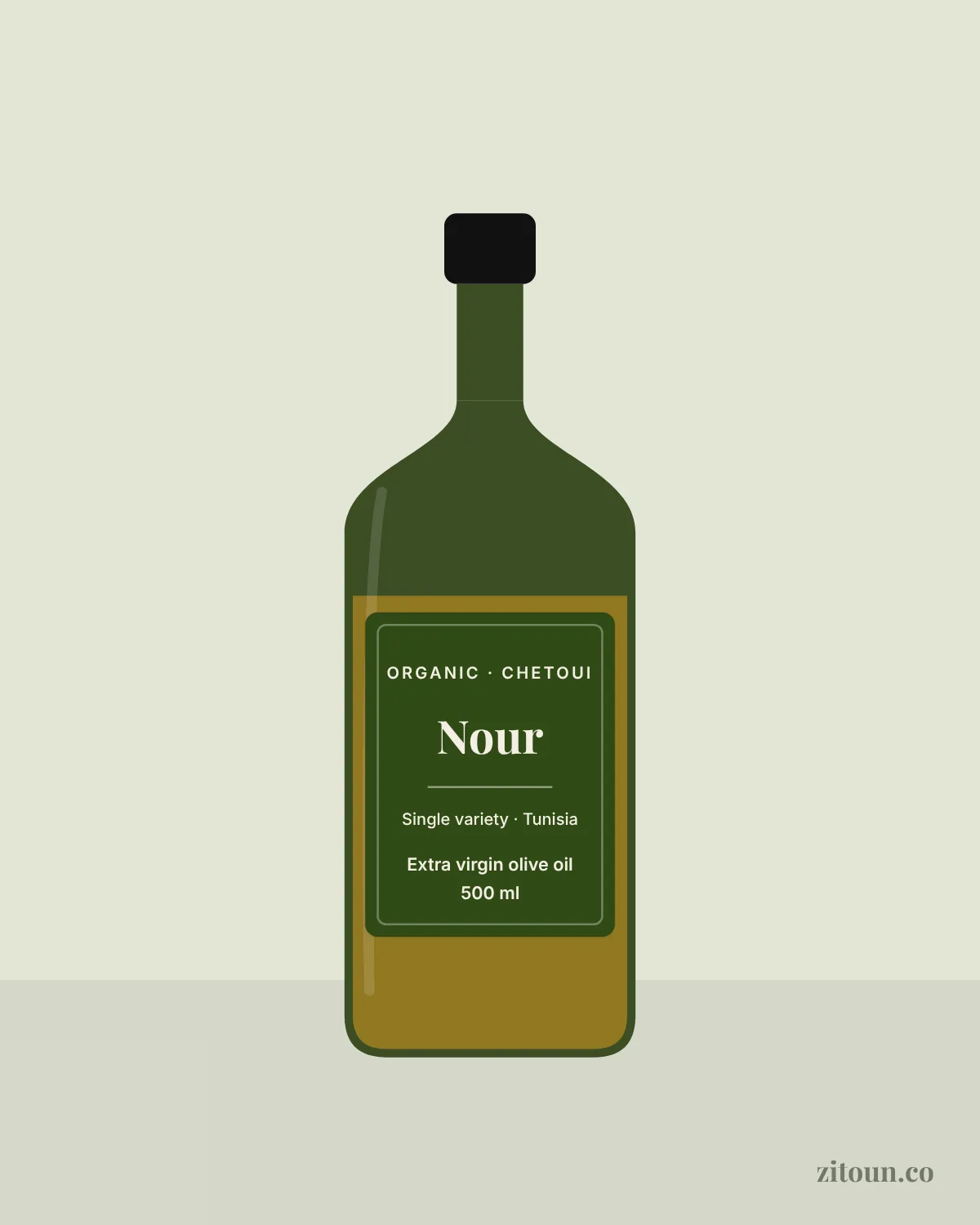
Tunisia produced about 500,000 tonnes of olive oil in the 2025/26 season, a national record, according to the Tunisian government. Most of it is exported, and most exports leave in bulk: in the first half of the season, 83% of exports were shipped in bulk and 12.5% bottled, according to Tunisia's National Agricultural Observatory (ONAGRI). Spain was the largest buyer, taking about a third of Tunisia's exports.
| Fact (2025/26 season) | Figure | Source |
|---|---|---|
| Production | About 500,000 tonnes | Tunisian government, via Wikifarmer |
| Exports to end of September 2026 | 399,000 tonnes | Wikifarmer |
| Share of exports shipped in bulk (Nov 2025–Apr 2026) | 83% | ONAGRI, via ANBA |
| Share shipped bottled (same period) | 12.5% | ONAGRI, via ANBA |
| Largest buyer | Spain, 32.3% of exports (Nov–Apr) | ONAGRI, via ANBA |
| Average export price, April 2026 | 12.67 TND/kg | ONAGRI, via Milling MEA |
For decades, Tunisian mills have sold bulk oil to large packers in Spain and Italy, who blend and bottle it under their own brands. Tunisia has pushed to export more bottled oil, and bottled exports have grown, but bulk is still the large majority. Buying bottled oil at the source keeps more of the value in Tunisia and gives you a clear origin to put on your label.
Chemlali is Tunisia's most planted variety, grown mainly in the centre and south around Sfax; it gives a mild, smooth oil. Chetoui grows mainly in the north; it gives a greener, more bitter and peppery oil. Compare them in detail.
Many Tunisian groves are rain-fed and farmed with few inputs, and organic olive oil is a growing share of exports: the government expected about 58,000 tonnes of organic oil exports for the 2025/26 campaign.
Olive trees often alternate a big harvest with a smaller one. After the record 2025/26 crop, Tunisian farm groups expect a smaller crop in 2026/27, which may push prices up. We will update this page with official figures as they are published.
Sources: ANBA (ONAGRI data) · Milling MEA (ONAGRI data) · Wikifarmer, week 44 2026 · Wikifarmer, 2026/27 crop
Tunisia produces a large share of extra virgin olive oil, and Tunisian producers regularly win international quality awards. As with any origin, quality depends on the mill and the batch, which is why each batch should come with a lab report. See how to read one.
Mostly because Tunisia sells in bulk and has lower production costs, not because the oil is worse. Much of the oil sold under European brands is blended with Tunisian oil.
Tell us what you want. We reply within 24 hours with samples and a price.
How Chemlali and Chetoui olive oils differ in taste, region and use, and which to choose for your brand, restaurant or gift.
Read more →How to read an extra virgin olive oil lab report: acidity, peroxide value, K232, K268, delta-K and the taste panel, with the EU and IOC limits.
Read more →Launch your own olive oil brand with Tunisian extra virgin olive oil. Your label, your bottle, from 200 bottles, delivered to the EU, UK, US and Gulf.
Read more →